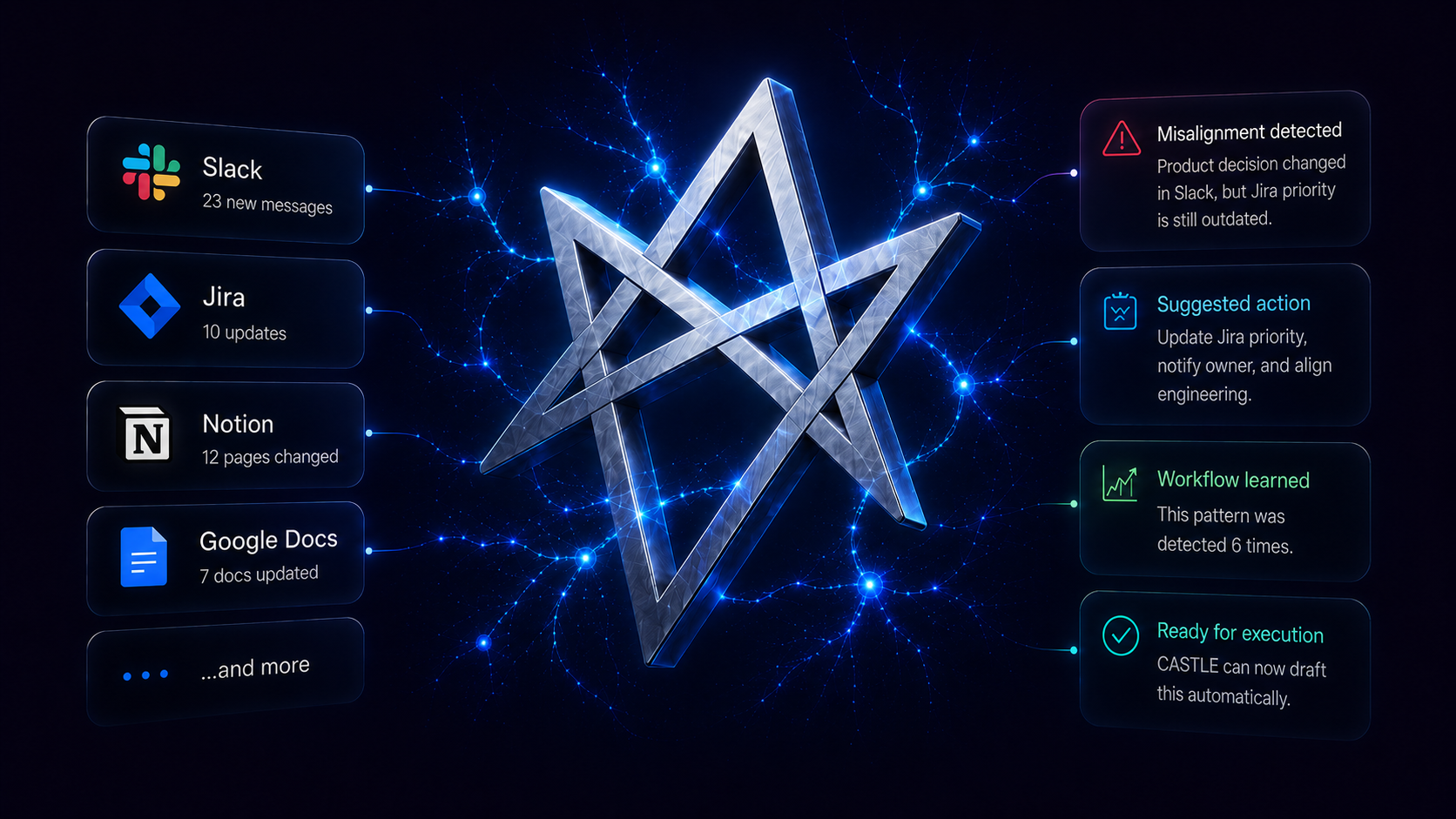
Scattered, overwhelming, unstructured
- Notes in Notion, Google Docs
- Action items buried in Slack threads
- Calendar events with no linked context
- Mental load of open loops and commitments
- No single operating picture of today

CASTLE turns fragmented context into a living memory, surfaces misalignments,
learns how work gets done, then just does it.
Different levels of autonomy. Only high-quality execution.
CASTLE builds a live operating model of your team: who owns what, what changed, what is blocked, and where people are acting on outdated context.
CASTLE catches priority drift before it becomes missed work.
CASTLE does not stop at search or summaries. It turns scattered Slack threads, docs, tickets, and updates into decisions, tasks, blockers, follow-ups, and drafted work.
Your team gets reviewed actions, not another inbox of AI summaries.
CASTLE starts with human-reviewed suggestions, learns from every accept or edit, and gradually earns permission to execute repeat workflows inside your tools.
Automation grows only after the team proves the workflow is safe.
AI is finally cheap enough to run continuously, and it will only get cheaper from here.
The next bottleneck is no longer raw intelligence, but structured context, memory, and execution.
We are approaching a point where systems can track, connect, and use more context than any person can manage alone.
Team Management System: A Real-Life Example.
In this demo, a task starts from a normal Telegram message in a group chat. CASTLE reads the request, loads the relevant company context, sees that there is no execution task in Jira yet, drafts the Jira task, and routes it to the human inbox for approval. Behind the scenes, CASTLE’s memory and learning layers keep improving from each iteration, so over time it can take on more work with higher confidence.
Interactive demo coming soon...

"I want to spend my life building technology, not chasing scattered context and manually operating a company. CASTLE is the system I wish existed: trusted automation for the ordinary work that keeps people away from creating the future."

"The hardest part of building isn’t execution — it’s keeping context alive. Ideas disappear between meetings, hypotheses lose their history, and teams forget why decisions were made. I want a system that thinks alongside us, structures the chaos, and preserves the thread of thought over time"
CASTLE is built from personal pain. Every feature exists because we experienced the cost of not having it.
We prioritize working software over decks. The interactive demo you just used is running on the same core we ship every day.
No feature gets added because other products have it. Every design decision is grounded in the execution layer model — state, proposals, approvals, audit.
Abstract assumptions are not enough. We talk to founders and employees, study how people describe the problem online, and turn repeated problems into product decisions.